
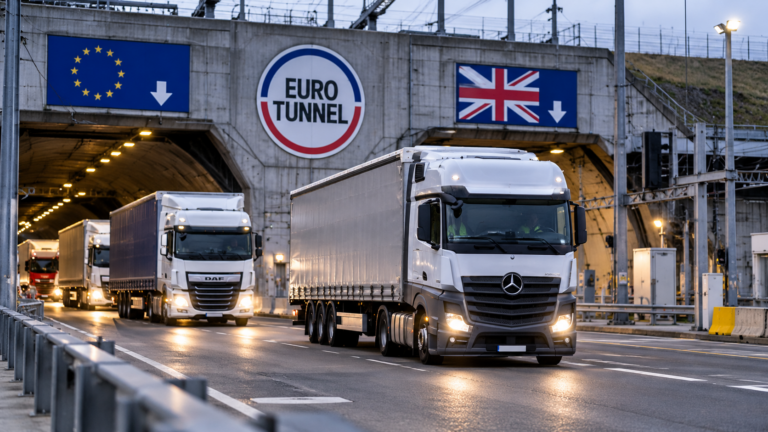
Every day, thousands of trailers transport food products, animal feed, raw materials and other goods between Great Britain and the European Union.
Since Brexit, the border has become a more prominent part of the logistics process. Certain goods require certificates, pre-notifications and official controls. But for hauliers and shippers, there is another, much more practical question:
Is the trailer suitable for the next load after unloading?
This question applies in both directions. It is just as relevant for a Dutch trailer travelling to Great Britain as it is for a British trailer returning to the European Union to collect another load.
The answer is not determined simply by the border the trailer crosses. The previous load, the next load and the requirements that apply to those products largely determine what level of cleaning is necessary.
The border does not automatically determine the cleaning method
There is no single “Brexit cleaning requirement” that applies to every trailer crossing between Great Britain and the European Union.
In practice, several factors must be considered:
What was transported in the trailer?
What will be transported next?
Is there a risk of contamination or cross-contamination?
Which product-specific regulations apply?
Are there additional customer or quality-system requirements?
A trailer that appears visually clean is therefore not automatically suitable for every subsequent load.
From Great Britain to the European Union
Goods entering the European Union from Great Britain may be subject to EU import requirements and official controls, depending on the type of product being transported.
For food transport, European hygiene legislation requires vehicles and containers used for transporting food to be kept clean and maintained in good condition to protect products from contamination.
Similar principles apply to animal feed, where contamination and cross-contamination must be controlled.
This means that the suitability of a trailer for its next load depends not only on whether it has crossed the border, but also on its previous use and the requirements associated with the next product.
From the European Union to Great Britain
Great Britain operates its own import and sanitary and phytosanitary controls.
Depending on the goods being transported, documentation, notifications and inspections may be required.
For certain product categories, cleaning requirements can also be very specific. Animal by-products are a clear example: vehicles and containers used for their transport may need to meet requirements relating to containment, cleaning, disinfection and drying.
Again, the key question is not simply whether the trailer has crossed the UK border, but whether it is suitable for the next transport operation.
Cleaning, disinfection and drying are different process steps
These terms are sometimes used interchangeably, but they describe different parts of the process.
Cleaning removes dirt, residues and other contamination from the trailer.
Disinfection is an additional step intended to reduce microorganisms to an acceptable level where this is required.
Drying removes remaining water or moisture and may be necessary before the trailer can safely or practically be used for another load.
Which steps are required depends on the combination of the previous load, the next load, the applicable requirements and the intended use of the trailer.
Return transport makes the issue more complex
International transport rarely consists of a trailer carrying the same product backwards and forwards.
A trailer may transport one type of load from the European Union to Great Britain and return with an entirely different type of product.
That makes trailer cleaning part of the logistics planning process.
The cleaning requirement has to fit between unloading and the next loading operation, without unnecessarily reducing trailer availability or disrupting transport schedules.
For fleets handling large numbers of trailers, this quickly becomes a capacity issue as well as a compliance issue.
The rules between Great Britain and the EU are changing again
The United Kingdom and the European Union are working towards a new sanitary and phytosanitary agreement intended to reduce trade barriers for certain agricultural and food products.
The British government is currently working towards implementation around mid-2027, although the final arrangements and timing are still subject to the negotiations and implementation process.
Such an agreement could reduce certain SPS documentation and physical controls between Great Britain and the European Union.
However, this does not mean that all border procedures will