
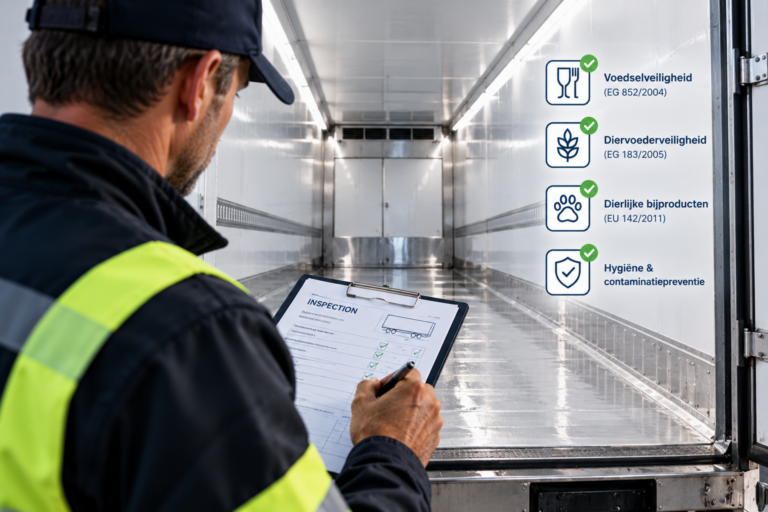
European and national regulations can impose different requirements on the cleaning and disinfection of trailers. Which requirements apply depends, among other things, on the previous load, the next load and the type of transport. Amborion brings these requirements together and translates them into a practical cleaning process.
European regulations set clear requirements for hygiene, food safety, feed safety and the prevention of contamination during transport.
For transport companies and logistics operators, this leads to a practical question:
When is a trailer sufficiently clean for its next load?
The answer is less straightforward than it may seem. There is no single cleaning method that is suitable for every trailer, every load and every situation.
The previous and next load determine the cleaning requirements
When assessing a trailer, it is not enough to consider only the next load. The previous load also plays an important role.
Residues, moisture, odours, allergens, microorganisms or other contaminants may pose a risk to the next load. Therefore, whenever the type of cargo changes, it must be determined whether the trailer is suitable for its next use.
Depending on the situation, different requirements may apply.
Food safety
When transporting food, vehicles and transport containers must be kept clean and maintained in such a way that food is protected against contamination.
When different products are transported consecutively, the trailer must be effectively cleaned between loads where necessary to prevent the risk of contamination.
The key question is therefore not simply whether the trailer looks clean, but whether it is hygienically suitable for the next food load.
Feed safety
Preventing cross-contamination is also important when transporting animal feed.
Residues from previous loads can affect the safety or quality of the next feed load. Depending on the combination of the previous and next load, specific cleaning requirements may therefore apply.
In practice, this means that the required cleaning process is not determined solely by the type of vehicle, but primarily by how the trailer is used.
Animal by-products
Additional European and national regulations apply to the transport of animal by-products.
Depending on the material, category and intended use, requirements may apply to the cleaning and disinfection of vehicles and containers.
Particularly when trailers are subsequently used for other products, it is important to determine exactly which cleaning measures are required before the trailer can be used again.
Hygiene and contamination prevention
Not every situation requires disinfection.
In many cases, thorough cleaning is sufficient, provided that residues, dirt and other potential sources of contamination are effectively removed.
In other situations, additional measures may be required, such as disinfection or the complete removal of residual water.
A fixed standard cleaning programme should therefore not automatically be assumed.
The required cleaning process must match the combination of vehicle, previous load, next load and the applicable requirements.
From regulations to a practical cleaning process
For companies operating only a few trailers, these requirements can often still be assessed individually.
With dozens or hundreds of trailers being processed every day, however, a different challenge emerges.
Regulations, cleaning programmes, capacity, registration and logistics planning must then be brought together into one reliable process.
The question is no longer simply:
How do we clean a trailer?
Instead, it becomes:
What cleaning does this trailer require before it can be used for the next load?
This is where compliance, logistics and engineering come together.
First determine what is required. Then choose the technology.
At Amborion, we deliberately do not reverse this order.
We do not start with a washing system.
We first look at the trailer, the loads, the relevant cleaning requirements, the required cleaning result and the day-to-day operation.
From there, we can determine what a practical cleaning process should look like and which technologies and automation are needed to achieve it.
Regulations define the framework. Daily operations determine how the solution needs to work in practice.
Do you know what is required for your trailers?
With the Amborion Cleaning & Compliance Check, we systematically assess the combination of vehicle, loads and cleaning requirements.
This creates clarity about the actual cleaning needs first — before discussing machinery, capacity or automation.